The Use of Windows Sandbox for the Secure Testing of Software

The Use of Windows Sandbox for the Secure Testing of Software
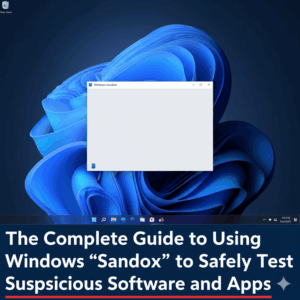
There is a potential for danger when you install unfamiliar or new software on your primary computer. It is possible that some apps include malicious software, hidden scripts, or undesirable system modifications that might undermine the stability or security of your personal computer. Windows Sandbox is a lightweight, disposable virtual environment that allows you to test applications in a secure environment without impacting your actual system. It is designed to be used in situations like these.
Sandbox is a feature that is included immediately into Windows 10 Professional, Windows 10 Enterprise, and all versions of Windows 11 (with the exception of Home, which requires manual activation). It generates a temporary desktop that is separated from the rest of the system and appears and functions in the same manner as a typical Windows installation. However, any actions you do inside it are erased as soon as you shut it.
The fact that it is completely risk-free makes it the ideal instrument for conducting experiments, tests, or executing questionable files.
1. What exactly is the Windows Sandbox?
Microsoft Windows Sandbox is basically a scaled-down version of Windows that is installed on your primary computer system. It does this by using the Hyper-V virtualization technology that Microsoft offers in order to provide a safe container in which applications may be run without having to interact with your core installation.
When you open it, you are presented with a pristine Windows environment that does not allow you access to any of your own files, registries, or applications that you have installed. When the sandbox is closed, all of the contents that were contained inside it, including the applications, settings, and files, are fully removed.
2. The Reasons Why You Should Make Use Of It
The standard virtual computers may be replaced with Windows Sandbox, which is a safer, quicker, and more straightforward option. It is ready to use as soon as you activate it, so there is no need to install additional software or establish complicated settings.
It works wonders for:
- Testing software or installs that have not been validated.
- The act of opening questionable attachments in emails
- Before putting a software into use at work, it is important to test its behavior.
Trying out different configurations or scripts without putting the system at danger of being damaged
3. Requirements for the System
Before you begin utilizing Windows Sandbox, check that your personal computer satisfies the following requirements:
- Window 11 Professional, Enterprise, or Education Edition
- Enabled virtualization in either the BIOS or the UEFI
- RAM of at least 4 gigabytes, with 8 gigabytes or more being optimal.
- 1 GB of unused space on the disk
- Two cores of the central processing unit (it is preferable to have four or more).
Sandbox may be manually enabled on Windows 11 Home by turning on Hyper-V via optional features or by using PowerShell commands. Sandbox can also be enabled from the command line.
4. Enabling the Windows Sandbox: How to Do It
in order to enable the feature:
- Locate Windows Features by opening the Start Menu and searching for it.
- Navigate to the Turn Windows features on or off menu.
- Windows Sandbox should be checked after scrolling down.
- After clicking the OK button, restart your computer.
You may open Windows Sandbox by searching for it in the Start Menu once it has been installed. Once it is installed, you will see it listed there.
5. Activating and Using the Windows Sandbox Environment
The appearance of Windows Sandbox is very similar to that of a brand new Windows 11 desktop when it is opened. Through the use of simple copy and paste, you will be able to transfer files or installers from your primary system into the sandbox from that location.
After you have a file inside, you are able to execute or install it in the same manner as you would normally. The distinction is that sandboxes are designed to keep everything confined inside their boundaries. If it turns out that the software is malicious or unstable, shutting the sandbox will immediately remove it from the system, leaving no traces behind, no changes to the registry, and no malware infestations.
6. Testing Software in a Risk-Free Manner
The installation for the new program may be tested by dragging and dropping it into the Sandbox window. As soon as you are inside, you are free to install and execute it without any concerns about any adverse repercussions.
If you have any reason to believe that a program could be malicious, this is the most secure method for ascertaining this. It is impossible for malicious software to escape or infect your real machine since Windows Sandbox is totally isolated. If you shut the window after you are finished, the environment will reset itself automatically.
7. Administration of Performance and Environments
Windows Sandbox consumes a portion of your system resources (RAM, CPU, and storage) while it is operating, which may result in a modest decrease in performance for computers with lower-end hardware.
Configuration files (.wsb) allow users with more sophisticated skills to exercise control over the behavior of the system. Options such as the following may be customized using these files:
- Folders that are shared
- Access to a network
- Utilization of GPU
- Scripts for starting up
For instance, you may build a.wsb file that lets you run Sandbox with a particular test folder or without internet connection. This is ideal for testing applications when you are not connected to the internet.
8. How Being Alone Can Help You Stay Safe
Everything that is included inside Sandbox operates independently from your primary system. This implies that you will not have access to your files, there will be no modifications made to the registry, and there will be no chance of infection. Even if malicious software is allowed to execute inside Sandbox, it will be removed once the window is closed.
Isolation is achieved by the utilization of hardware, using the same technology that underpins Microsoft Defender Application Guard. This guarantees that your core environment is completely separated from the isolation.
9. Examples of Everyday Use
Windows Sandbox is something that many experts utilize for:
- Evaluation of unidentified software installers prior to the installation of software on a business network
- Obtaining evidence of how changes to the system effect performance
- Opening files that are zipped or attachments that are not trusted
- Execution of portable applications (temporary)
- Making changes to the registry or scripts in a secure testing environment
When it comes to obtaining tools from the internet or confirming the compatibility of older software, even regular users may profit from it thanks to its capabilities.
10. Problems with the Sandbox and Some Solutions
If you are unable to launch Windows Sandbox, check to see if virtualization is enabled in your computer’s BIOS. You may verify this by opening Task Manager, selecting the Performance Tab, and then selecting CPU. Then, search for the phrase “Virtualization: Enabled.”
Additionally, make sure that Hyper-V and any other services that are associated with it are activated. Consider closing any apps that are running in the background or allocating extra memory to the system if performance seems to be poor.
11. Benefits Not Available with Virtual Machines
In order to use traditional virtual machines such as VMware or VirtualBox, separate installs, system images, and manual setups are required. On the other hand, Windows Sandbox starts up immediately and resets itself automatically when it is removed from the system.
A practical solution for daily testing rather than long-term virtual environments, it is lightweight, quick, and properly integrated into Windows. It is a solution that is practically useful.
12. Concerns Regarding Personal Integrity and Safety
Despite the fact that Sandbox offers a high level of isolation, files that are copied into it are visible while it is open. Move critical data inside the building unless it is absolutely essential. Moreover, keep in mind that any modifications done inside the Sandbox are just temporary; for example, if you install a program and then shut the Sandbox, the software will be removed the next time you access it.
Alternately, you may want to think about utilizing a virtual computer for permanent testing.
As one of the most powerful security and productivity capabilities that are integrated into Windows, Windows Sandbox is one of the most useful utilities. Due to the fact that it combines the most advantageous aspects of virtualization and system protection, it enables you to test software, surf the internet without risking damage to your computer, and explore without any concerns.
Enabling Windows Sandbox is one of the most prudent and secure actions you can do, particularly if you often download new apps or like experimenting with different configurations. You are free to explore without putting your primary system at danger, which is a significant benefit.