Using Neural Filters for Advanced Lighting Re-Creations
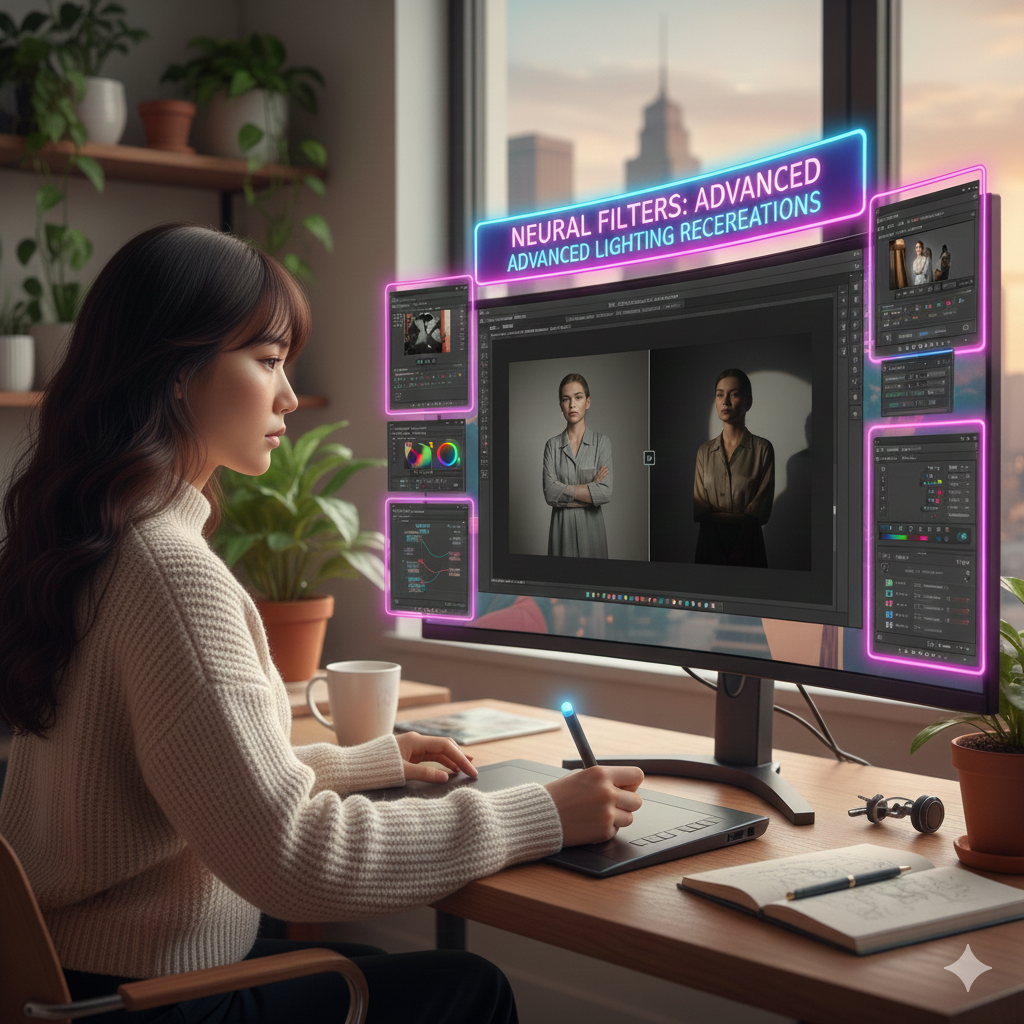
Using Neural Filters for Advanced Lighting Re-Creations
The use of neural filters in Photoshop has fundamentally altered the way in which digital artists, photographers, and designers approach the process of picture editing. One of the most intriguing uses of these tools is sophisticated lighting re-creation, which enables users to make significant changes to the direction, intensity, and style of a picture with a small amount of human labor. Through the use of artificial intelligence-driven analysis, Neural Filters are able to recreate realistic lighting conditions, hence boosting mood, depth, and visual storytelling in a manner that is not disruptive.
Gaining an Understanding of Neural Filters and the Re-Creation of Lighting
Neural Filters are filters that assess a picture via the use of machine learning and then produce intelligent modifications. These filters, in especially the “Smart Portrait” and “Light” filters, have the ability to change shadows, highlights, and overall illumination, so producing lighting effects that are either natural or aesthetic. These artificial intelligence-driven technologies, in contrast to conventional human procedures, read the geometry, surroundings, and textures of the subject. This enables complicated lighting modifications to be made without the need for laborious masking or layer adjustments by hand.
The process of preparing the image for adjustments using neural filters
In order to acquire the best possible results, you should start with a picture that has a high quality and a distinct topic separation. In order to maintain the integrity of the initial data and enable non-destructive editing, the primary layer should be converted into a Smart Object. In order to provide realistic illumination changes, it is vital to ensure that the Neural Filter is properly prepared so that it can effectively evaluate depth, contours, and material qualities.
Utilizing Neural Filters and Having Access to Them
In order to access Photoshop’s collection of AI-driven tools, go to the Filter menu and choose Neural Filters. When you want to recreate the lighting, you should activate the “Smart Portrait” filter. This filter has sliders that allow you to modify the light direction, brightness, and shadow strength accordingly. You are able to replicate ambient and studio lighting effects using the “Lighting” neural filter, which is available in more recent versions of Photoshop. This filter lets you to imitate key, fill, and rim lights. The user interface offers real-time previews, which makes the process of experimenting less complicated and more iterative.
Modifying the Direction and Intensity of the LightSource
For the purpose of lighting re-creation, the first step is to determine the direction of the light source. One of the capabilities of neural filters is the ability to rotate light around the subject, so altering the positioning of shadows and highlights. The intensity sliders alter the degree to which the light is noticeable, allowing for nuanced adjustments that may be used to achieve either dramatic emphasis or reality. These parameters, when combined, have the ability to replicate daylight, interior lighting, or studio lighting for a cinematic experience.
Improving the Space’s Depth and Dimension
It is not only possible to modify the lighting using neural filters, but they also improve the feeling of depth. It is possible for the artificial intelligence to discreetly accentuate contours and textures by modifying lighting and shadows depending on the geometry of the face or object. Through the use of this technique, portraiture may be made to look more three-dimensional, and items in commercial photography can be made to appear more sculpted and visually prominent, making the photographs more realistic and appealing to the eye.
Utilizing Filters in Conjunction with Layer Masks
In spite of the fact that Neural Filters are capable of making automated modifications to the illumination, layer masks may be used to selectively apply effects. To give you an example, you could wish to keep the backdrop the same while simply making adjustments to the lighting of the topic. Through the use of masking, artificial intelligence-driven light modifications are able to blend smoothly with the components that surround them, therefore maintaining the compositional integrity.
When attempting to achieve complex effects, using several neural filter passes
The use of more than one pass is often necessary in advanced lighting conditions. As an example, you may begin by applying broad directed light by using the main filter, and then proceed to increase facial or surface highlights by utilizing a second modification to the Neural Filter. It is possible to keep control and make adjustments to the intensity, blending, and masking of the Smart Object layers by applying each pass on individual Smart Object layers.
The Adjustments Made to the Color Temperature and Mood
Light has an effect on how colors are perceived. Mood and tone may be created more effectively with the use of neural filters, which can replicate warm, cold, or neutral lighting conditions. In order to guarantee that the re-created lighting seems natural and constant across the picture, this may be accomplished by adjusting the temperature and tint in combination with the shadows and highlights. This will enhance the visual narrative.
Traditional Adjustment Layers Are Integrated Into the System
In addition to the standard Photoshop modifications, Neural Filters are now available. After applying lighting that is based on artificial intelligence, you may use Curves, Levels, or Gradient Maps to make adjustments to the contrast, saturation, or exposure. This layered method offers the highest level of versatility, combining the intelligence of automated artificial intelligence with the accuracy of human labor to produce outcomes of professional quality.
Maintenance of a Workflow That Is Not Destructive
While working on Smart Object layers, any alterations made to the Neural Filter will continue to be changeable. It is possible to return to, change, or eliminate lighting effects without causing the original picture to become less attractive. When it comes to iterative processes, client modifications, or experimental creative initiatives, this non-destructive technique is very necessary.
Final touches and enhancements to the sense of realism
To finish the process of recreating the lighting, make sure that the shadows, reflections, and highlights are all consistent with one another. It is possible to further increase realism by doing little brushwork on masks, applying subtle gradient overlays, or making localized Dodge and Burn modifications. A polished and professional finish that is ideal for editorial, commercial, or creative purposes is achieved via the combination of Neural Filters and human adjustment.
Through the use of Neural Filters for the purpose of sophisticated lighting re-creations, designers and photographers are able to turn regular photographs into visually captivating compositions that have illumination that is either realistic or styled. You are able to change the direction of light, the strength of the light, and the color temperature while maintaining a workflow that is completely non-destructive by using analysis, adjustment layers, and masking that are driven by artificial intelligence. When it comes to contemporary Photoshop processes, having a command of these tools enables more creative freedom, speed, and accuracy.