Deep Etching Transparent Objects: Using the ‘Knockout’ Blending Option for Glass and Liquid Shadows
Deep Etching Transparent Objects: Using the ‘Knockout’ Blending Option for Glass and Liquid Shadows
One of the most technically challenging chores in Photoshop is deep etching translucent objects. This is due to the fact that transparent materials interact with light in a variety of sophisticated ways. Due to the fact that glass containers, liquid surfaces, and reflective polymers do not react in the same manner as solid objects, typical masking approaches are not suitable for rendering realistic extractions results. When using traditional cutout techniques, it is common practice to eliminate tiny shadows, internal reflections, and transparent edge features, all of which are necessary for effectively preserving realism. The Knockout blending option provides a more sophisticated method by enabling selective transparency effects inside layered compositions. This ability allows for more realistic renderings. Knockout gives editors the ability to isolate transparency while keeping an essential amount of tonal and lighting information, as opposed to depending only on destructive masking. When it comes to commercial product photography, where bottles, drinks, and cosmetic packages need to seem natural against a variety of backdrops, this method is extremely helpful. By gaining an understanding of the ways in which Knockout blending impacts layer groups and transparency settings, it is possible to achieve extractions that are both cleaner and more adaptable. By using this technology in the appropriate manner, it is possible to create realistic transparent object composites without compromising the depth of shadows or surface details.
Acquiring an Understanding of the Obstacles Faced by Etching Transparent Objects
Transparent objects provide a unique set of challenges due to the fact that they comprise both apparent structure and partly transparent portions that are significantly dependent on the lighting circumstances of their surroundings. When it comes to liquids, traditional masks are unable to correctly separate the gentle gradients and internal reflections that are present in liquids. Glass edges may seem dazzling in one region and practically undetectable in another. Materials that are transparent, in contrast to those that are opaque, cannot be easily picked and separated from their backdrop without sacrificing crucial optical qualities. There are many factors that contribute to the final look of the item, including refraction, highlight diffusion, and shadow transparency. It is necessary to have a procedure that distinguishes between the information about transparency and the structure of solid objects in order to preserve these features. Because poor extraction may rapidly make transparent goods look unnatural or artificially carved out, it is necessary to have a thorough understanding of these problems before trying advanced etching processes.
Describe the operation of the Knockout Blending Option
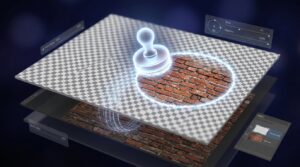
The Knockout blending option alters the behavior of layer transparency by enabling some layers to punch through the material that lies underneath them inside a group or document. By creating controlled transparency interactions, Knockout is able to disclose deeper layers while maintaining tonal transitions. This is in contrast to the traditional method of just concealing pixels. Both shallow and deep Knockout modes are available in Photoshop. Each of these modes has a different effect on how transparency operates across grouped layers. As a result of the fact that Deep Knockout spreads the transparency effect across the whole document hierarchy, it is very handy for compositing transparent objects. With the help of this capability, editors are able to separate glass surfaces and liquid shadows while yet preserving a realistic relationship with the backdrop. It is essential to have a solid understanding of the differences between Knockout and regular opacity modifications in order to operate successfully with Knockout in sophisticated masking processes.
Getting Transparent Product Images Ready for Removal from the Database
Preparing the source picture in such a way that it retains the maximum amount of information is necessary before employing the Knockout blending technique. Because transparent objects often have delicate highlight and shadow transitions, exposure balancing is particularly crucial because these transitions might be lost if the tonal range is squeezed. First things first: before commencing the extraction process, you should make sure that you have cleaned reflections, removed sensor dust, and adjusted the white balance. The tiny edge features and subtle transparency gradients that are present in high-resolution source photos are preserved throughout the editing process, which results in more flexibility. During the first stage of photography, it is beneficial to isolate the item against a controlled backdrop. This helps to increase contrast between transparent surfaces and the regions that are around the object. In order to guarantee that the Knockout process generates results that are cleaner and more accurate, proper preparation is required.
Controlling the behavior of transparency via the use of layer groups
Using knockout mixing in conjunction with organized layer groups results in the highest level of effectiveness. Editors are able to exert a greater degree of control over the manner in which transparency interacts with shadows, reflections, and background layers when they organize transparent object elements into separate groups. It is possible, for instance, to arrange information about shadows, liquid contents, and glass edges on various levels inside the same group. It is possible for transparent sections to interact naturally with lower levels by applying Deep Knockout to chosen layers. This allows for the preservation of nuanced optical features. The use of this grouped technique avoids unintended transparency effects from having an influence on portions of the composition that are not connected to one another. In addition, the proper structure of layers enhances the flexibility of the process, which makes future alterations simpler and more under control.
Keeping the Highlights and Reflections of the Glass in Good Condition
Compositing realistic transparent objects requires a number of different features, one of the most significant of which is the maintenance of highlight structure and interior reflections. These visual aspects give glass and liquids a sense of depth and realism, respectively, by defining the material qualities of the materials. It is common for standard masking procedures to flatten or eliminate these nuances, which results in the item seeming fake. There is the possibility that highlights and reflections may continue to be partly visible even after transparent portions have been separated from the background when using Knockout blending. The item is able to keep its natural interaction with light as a result of this. Through the use of selective blending and careful modifications to the opacity, reflective features are able to maintain their equilibrium without coming to dominate the composition. The preservation of these features is very necessary in order to provide product images of a professional standard.
the preservation of the natural shadows and refractions of liquids
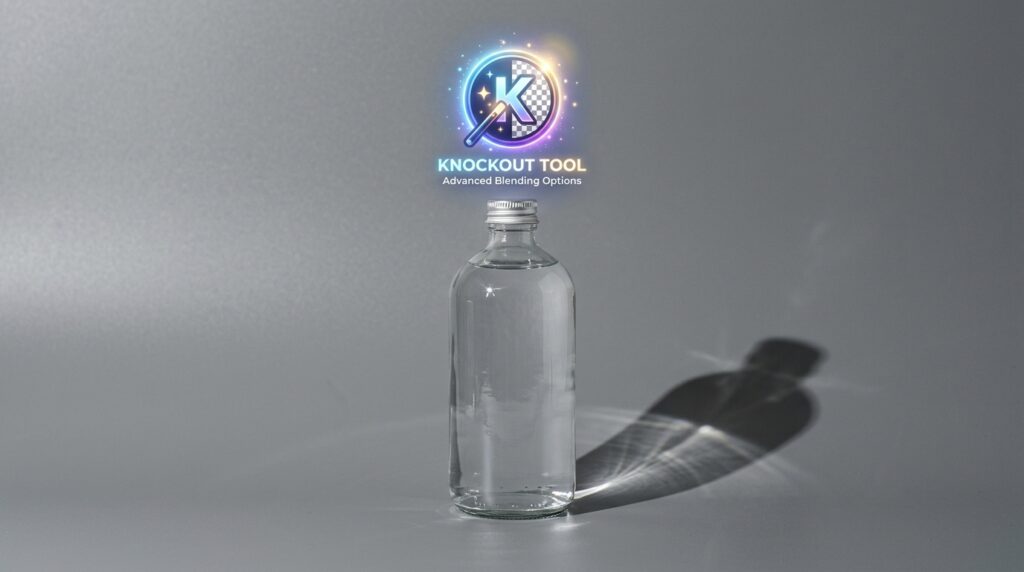
Liquid shadows are distinct from solid shadows due to the fact that they often exhibit minor hue changes and partial transparency as a result of refraction. By removing or simplifying these shadows, it is possible to provide the impression that drinks or clear containers are independent from the surface that is underneath them. It is possible to keep these transparent shadows incorporated into the final composite by using knockout blending, which also enables the item to stay distinct from its original backdrop. Editors are able to maintain the subtle gradients and refracted light patterns that contribute to higher levels of realism by adjusting how transparency penetrates across grouped layers. It is notably helpful in the advertising of beverages and in the photography of cosmetics, both of which are areas in which the look of liquids plays a significant role in the presentation of products.
Utilizing Knockout in conjunction with Advanced Masking Instructions
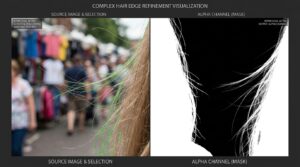
Despite the fact that Knockout blending is a strong technique, it is most effective when used in conjunction with other non-destructive masking techniques. While Blend If settings may assist in isolating tonal ranges inside translucent surfaces, Layer Masks can have the ability to refine edge visibility. There is also the possibility that channel-based choices may help in the preservation of delicate highlights and semi-transparent features. The combination of these methods results in a process that is more adaptable, precise, and versatile, and it can accommodate a variety of transparent fabric kinds. When it comes to large composites, in order to preserve realistic depth and lighting behavior, numerous masking systems often collaborate with one another. The use of this tiered method allows for better control over each and every part of the extraction process, while at the same time ensuring that alterations are completely changeable.
Finding Ways to Avoid Making Common Errors When Compositing Transparent Objects
Transparent object compositing calls for a high level of nuance and accuracy, and a number of simple errors may severely diminish the sense of realism. The removal of shadows to an excessive degree might give the impression that things are floating or separated from their surroundings. An excessive amount of contrast adjustments has the potential to ruin not just reflected detail but also delicate transparency gradients. An further prevalent problem is the application of Knockout effects without adequate layer structure, which results in undesired transparency artifacts across the composition. Ignoring the constancy of the lighting in the area might further contribute to the overall lack of realism in the final picture. It is helpful to preserve realistic results by doing regular evaluations of the composite in comparison to the original lighting arrangement. When it comes to making translucent object extractions that seem natural upon closer examination, careful refining and controlled modifications are very necessary.