How to Stop Photoshop from Auto-Converting PNG UI Assets to CMYK on Import
How to Stop Photoshop from Auto-Converting PNG UI Assets to CMYK on Import
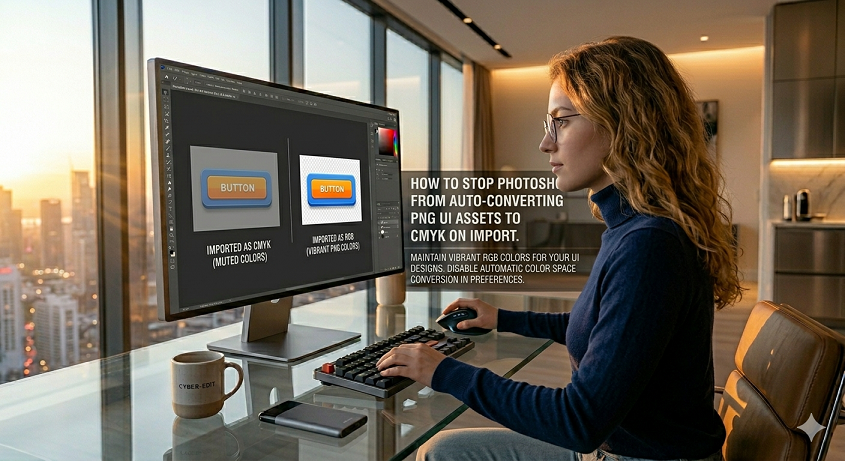
When working with user interface materials in Photoshop, it is essential to have perfect color accuracy, particularly when designing for digital platforms and the web. Photoshop’s tendency to automatically convert imported PNG files into CMYK color mode is a problem that many designers encounter. This conversion may cause colors to become distorted and can also disturb the design that was intended. When working with user interface elements, where precise color representation is essential for maintaining consistency and ensuring usability, this issue brings about a particularly uncomfortable experience. In many cases, the transition from RGB to CMYK results in colors that are incorrect or dull, which causes assets to seem differently than they did when they were first created. This may have a detrimental influence on screenshots, mockups, and interface graphics for designers and bloggers that work in the technology industry. Preventing this automated conversion is absolutely necessary in order to preserve the integrity of the design and maximize the efficiency of the process. You are able to guarantee that your PNG assets will continue to be in the appropriate color space if you configure the appropriate parameters and have a solid grasp of how color management works. In order to prevent making many mistakes, it is helpful to establish a consistent import method. In order to provide dependable and professional user interface graphics, mastering this setup is essential.
Comprehending the Reasons Behind Photoshop’s Conversion of PNG Files to CMYK
It is possible for Photoshop to convert PNG files to CMYK owing to the color mode or color management settings that are already in place. It is possible for any imported asset to automatically adjust itself to fit the CMYK mode if the working document is configured to that standard. This behavior is intended for processes that include printing, but it is not appropriate for projects that use the web. There is also the possibility that the color profiles that are encoded in the PNG file will affect how Photoshop sees the picture. When profiles do not match, automated conversions may be triggered under certain circumstances. Color changes and inconsistencies may occur as a result of this unanticipated occurrence. Having an understanding of this behavior enables you to determine the underlying reason of the problem. In addition to this, it emphasizes the need of coordinating your workflow with the format that is meant to be produced. The first step in avoiding conversions is to have an understanding of the reasons why they could occur. Maintaining the correct setting guarantees predictable outcomes.
Establishing the Appropriate Color Mode for Web Work as the Default
Setting your default working color mode to RGB is very necessary if you wish to avoid conversions that are not needed. It is because of this that all newly imported assets and documents are brought into conformity with web standards. RGB is the color space that is most often used for digital material because it is compatible with the way that displays show colors. Working with RGB allows you to keep all of the user interface elements and graphics consistent with one another. It is possible to lessen the likelihood of making CMYK conversions by mistake by making this your default setting. Additionally, it enhances the efficiency of your operations by removing the need for manual changes. Keeping the color mode consistent is really necessary in order to keep the accuracy. This stage is responsible for laying the groundwork for a dependable design process. Setting up your assets correctly assures that they will act as you anticipate.
It is possible to prevent automatic conversion by adjusting the color settings.
The way in which files are imported and handled in Photoshop is significantly impacted by the color options that are available. If you properly configure these parameters, you may prevent the conversion to CMYK from occurring automatically. Among them are the establishment of regulations that prioritize the preservation of embedded profiles above their conversion. It is possible to guarantee that photographs have their native color space by disabling the automated profile mismatches feature. Additionally, it is essential to activate alerts for profile changes, which will help you to make well-informed judgments while the import is being performed. Because of these improvements, you will have a better degree of control over the management of assets. The chance of unanticipated modifications is decreased when the setup is done correctly. Additionally, it enhances the general uniformity of the process. For professional results, it is very necessary to spend some time adjusting these parameters to perfection.
Using “Place Embedded” rather than Direct Import as an Alternative
The way in which PNG files are imported into a document may have an impact on the way in which those files are handled. When it comes to reliability, direct import is often less dependable than using a placement approach that maintains the attributes of the original file. With this method, the asset is preserved in the color space in which it was originally created, and automated conversion is avoided. Moreover, it enables non-destructive modification, since the asset continues to be tied to the data that it was originally derived from. This comes in especially handy for user interface elements that could need an upgrade or replacement in the future. If you choose the appropriate method of import, you will be able to have a higher degree of control over your assets. This method is a straightforward approach that is quite successful in preventing color problems. Both the flexibility and the accuracy of your process are improved as a result.
Controlling and Monitoring the Color Profiles That Are Embedded
Color profiles that are embedded into PNG files have the potential to affect how the files are shown and how they are understood. It is essential to determine if a file includes a profile and to evaluate how well it corresponds with the settings you use for working. Profiles that do not match may result in automated conversions or warnings being triggered. By managing these profiles, you can guarantee that the colors across the various assets are consistent with one another. Depending on the circumstances, it may be required to either remove or standardize profiles. Your design environment will be easier to maintain homogeneity as a result of this. When you have a better understanding of how profiles function, you will be able to make better judgments throughout the import process. Color changes that are unanticipated may be avoided with proper management. You may be certain that your graphics will continue to be correct and constant.
Preventing the Use of Multiple Color Modes Within a Single Workflow
When working on a single project, combining several color modes might result in confusion and discrepancies with the final product. When some elements are represented in RGB and others are represented in CMYK, it becomes challenging to maintain a consistent representation of colors. Because of this, the behavior that occurs when editing and exporting may be unexpected. When all of the assets are kept in the same color mode, the process is simplified, and the number of mistakes is reduced. In addition, it guarantees that the colors will be uniform across all of the components. When it comes to your initiatives, establishing a defined standard is helpful in maintaining order. In digital design, it is recommended that mixed modes be avoided if possible. Your job will be more accurate and efficient as a result of its help.
Before exporting, ensuring that the colors are accurate
Before you export your final photos, it is essential to check that all of the assets are in the appropriate color mode. This involves ensuring that each individual layer and embedded item is consistent with every other layer. By seeing the picture in a variety of situations, it is possible to spot any inconsistencies that may exist. Unanticipated color changes on the web may be avoided by ensuring that everything is in the RGB color space. Before the publication of the work, this phase serves as the last quality check. This helps to ensure that the integrity of your graphics is preserved. Consistent verification helps to lower the likelihood of making mistakes. In addition, it guarantees that the information you produce is up to professional standards. To get findings that may be relied upon, careful evaluation is required.
Establishing a Workflow That Is Consistent With Color Management
When it comes to preventing problems with PNG imports and CMYK conversions, having a color management approach that is consistent is absolutely necessary. Standardizing settings, using appropriate import techniques, and doing routine process reviews are all necessary steps in this process. By documenting your process, you can assist ensure that your projects are consistent with one another. Automated tools and settings may further simplify the process and make it more efficient. In order to lessen the probability of making mistakes, you should develop detailed rules. All assets will act in a predictable manner if consistency is maintained. Additionally, it enhances productivity by reducing the number of human errors. Long-term success is supported by a process that is well established. To get more precise and professional results in design, it is necessary to make an investment in effective color management.