How to Force Specific Windows Apps to Run on E-Cores vs. P-Cores
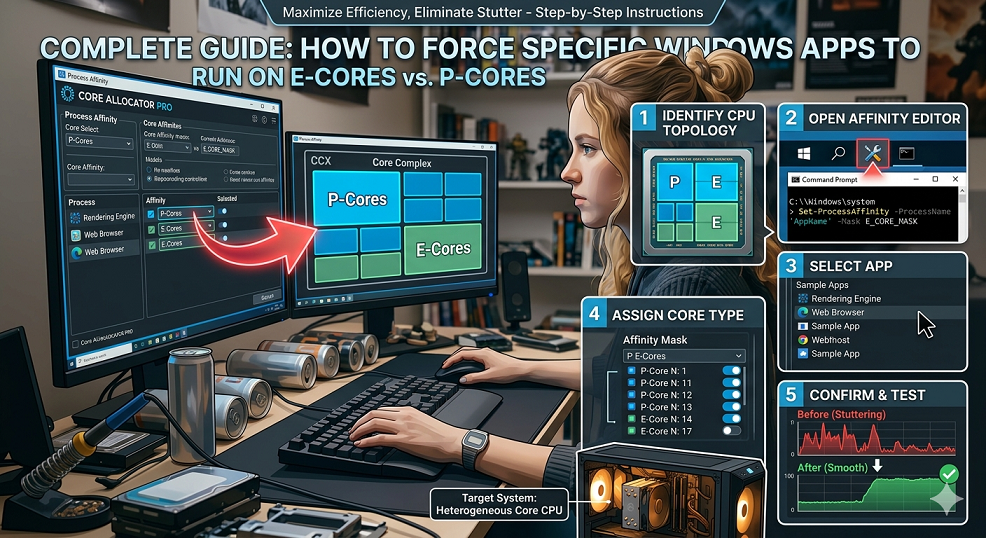
How to Force Specific Windows Apps to Run on E-Cores vs. P-Cores
Modern central processing units (CPUs) with hybrid designs have a combination of performance cores and efficiency cores, which are intended to achieve a balance between power distribution and task allocation. Despite the fact that this architecture makes the system more responsive as a whole, it has the potential to produce inconsistencies while running certain programs, particularly when benchmarking or doing activities that are resource-sensitive. It is possible that some apps will not automatically employ the appropriate core type, which might result in performance that is less than optimal or excessive waste of power. When it comes to power users, tech bloggers, and reviewers, having the ability to choose which cores a program runs on is a huge benefit. It is possible to increase performance by forcing applications onto P-cores, while improving efficiency may be accomplished by allocating background jobs to E-cores. Although Windows comes with its own built-in scheduling systems, these mechanisms may not always act in a predictable manner. You are able to fine-tune the way in which apps interact with your central processing unit (CPU) by manually changing core affinity and system parameters. As a consequence, this leads to improved performance consistency as well as greater accuracy in testing situations. It is very necessary to have a solid understanding of how to control this process in order to optimize current hybrid CPUs.
Acquiring an Understanding of the Distinction Between P-Cores and Eco-Cores
The purpose of performance cores is to facilitate high-speed, demanding operations that call for the greatest amount of processing power. Some examples of these tasks are gaming, rendering, and benchmarking. On the other side, efficiency cores are designed to perform low-power background operations and multitasking situations in the most efficient manner possible. Due to the fact that they produce less heat and require less energy, they are well suited for operations that are relatively light. Workloads are distributed across these cores in a dynamic manner by the operating system, which takes into account the demand. On the other hand, this computerized scheduling does not necessarily correspond to the expectations of the actual users. It is possible for some programs to run on E-cores even if they would benefit more from the performance of P-cores. It is helpful to have a thorough understanding of the functional distinctions between these cores in order to make educated judgments about the allocation of workloads. Having this information is necessary in order to maximize the functioning of the system. The correct allocation of cores guarantees that each mission is executed on the hardware that is most suited for it.
Manually setting the CPU affinity with the use of Task Manager
Setting CPU affinity with system management tools is one of the easiest methods to control which cores a program utilizes. This is also one of the most effective techniques. It is possible to designate the specific cores that a process is able to execute on thanks to this. You are able to compel an application to utilize either performance or efficiency cores by choosing just the cores that you wish to use. It is necessary to use this procedure each time the program is started, despite the fact that it permits rapid control. In particular, it is helpful for testing and making alterations that are just temporary. Although it is effective, it needs human interaction and may not be suitable for usage over an extended period of time. Having a working knowledge of how to utilize this feature gives you direct control over the functionality of the CPU. Managing core allocation may be accomplished using this as a reasonable starting point.
Making Use of System Power Plans in Order to Prioritize Core Considerations
Power plans have an impact on the manner in which the operating system allocates tasks across the various cores. Plans that prioritize high performance are more likely to use P-cores, while plans that prioritize power efficiency or balance may make use of E-cores more often. The modification of these variables allows for the indirect control of core consumption without the need for explicit affinity assignment. Rather of being effective for application-specific control, this technique is good for universal optimization. Changing the power parameters to a finer degree helps match the behavior of the system with your performance objectives. This also guarantees that the central processing unit (CPU) functions well under a variety of workloads. It is possible to get extra control by gaining an understanding of how power plans impact scheduling. In addition to existing methods for regulating core consumption, this strategy is a useful supplement. The performance of the system may be influenced in a straightforward and efficient manner.
Utilizing Proficient Scheduling Tools in Order to Maintain Consistent Control
There are complex scheduling technologies that can be used to automatically allocate programs to certain cores, which may be employed for more permanent solutions. You will be able to define rules that will be applied each time an application is started with the help of these tools. Because of this, there is no longer a need for manual changes, and behavior is maintained consistently. Differentiating between P-cores and E-cores based on the architecture of the system is possible using these kinds of tools. You are able to improve performance for certain apps by customizing these rules. This comes in very handy when benchmarking or doing operations that are repetitious. The efficiency and consistency of the process are both improved by persistent control. Additionally, the possibility of human mistake is decreased. Tools that are more advanced provide a greater degree of accuracy when it comes to managing the CPU.
The process of configuring the BIOS settings in order to optimize core behavior
Different configurations of the system’s firmware may have an effect on the way cores are displayed to the operating system. Certain settings provide you the ability to activate or disable certain cores, as well as modify the behavior of those cores. You may establish a more controlled environment for testing or performance tweaking by adjusting these variables. Both of these activities are possible. In order to guarantee that all tasks are carried out just on P-cores, for instance, E-cores might be disabled. The usage of this might be beneficial in benchmarking situations when consistency is of the utmost importance. Nevertheless, modifications at this level must to be carried out with caution since they have an impact on the whole system. An understanding of the available firmware choices allows for more control over the performance of the CPU. Advanced users who are looking for the highest possible level of accuracy should utilize this strategy.
Making Background Processes More Efficient in Their Use of E-Cores
When background activities are assigned to E-cores, it helps free up P-cores for high-performance workloads at the same time. It is possible to do this by establishing affinity or by using scheduling tools to reroute apps that are not the most important. The rivalry for CPU resources may be reduced by separating activities that occur in the background. Consequently, the performance of major apps like games and benchmarks is enhanced as a result of this. Increased overall system responsiveness may be achieved via effective task allocation. Additionally, it lowers the amount of heat produced and consumes less electricity. The management of operations that run in the background is an essential component of optimization. It is via this technique that resources are used in an efficient manner. The performance of the system is improved when it is allocated correctly.
Monitoring the Core Requirements in Order to Improve Decision Making
Real-time insights into how applications make use of various cores may be obtained via the use of monitoring programs. You will be able to detect areas of inefficiency and make adjustments to your settings based on the findings of this analysis. It is possible to establish whether or not an application is operating on the cores that are wanted by observing the patterns of core consumption. For the purpose of fine-tuning your settings, this information is absolutely necessary. The use of continuous monitoring guarantees that your improvements will continue to be effective over time. It also assists in identifying any conduct that is unexpected. Data-driven adjustments lead to better performance outcomes. Understanding system activity is key to effective optimization. Monitoring is an essential part of managing hybrid CPUs.
Creating a Repeatable Workflow for Core Allocation
Consistency is crucial when managing core allocation across multiple applications or tests. Establishing a repeatable workflow ensures that your settings are applied correctly every time. This may include predefined affinity rules, power plan configurations, and monitoring routines. Documenting your process helps maintain accuracy and efficiency. A structured approach reduces the likelihood of errors and improves productivity. It also ensures that results are consistent across different scenarios. Repeatability is especially important for benchmarking and performance analysis. By standardizing your workflow, you can achieve reliable and professional results. A well-defined system supports long-term optimization and control.