Exporting Custom Photoshop Color Profiles as 3D LUTs for Cross-Platform Video Editing
Exporting Custom Photoshop Color Profiles as 3D LUTs for Cross-Platform Video Editing
Due to the fact that projects often travel across several platforms, such as photography, motion graphics, video editing, and digital publication, maintaining color constancy has become an increasingly critical aspect of current creative processes. Creating a color grade in Photoshop may look great for still photographs, but if there is no standardized system in place, it may be challenging to keep the same visual style throughout all of the video editing apps. At this point, three-dimensional lookup tables, often known as 3D LUTs, become absolutely necessary. By storing color transformation data that can be applied consistently across multiple software settings, a 3D LUT enables editors to duplicate the same grading style in video programs, motion graphics software, and picture processes. This is made possible by the fact that the data can be applied consistently. Using the extensive color modification tools that Photoshop offers, one may create individualized grading profiles and then export them as LUT files to ensure that they are compatible with several platforms. Having a solid understanding of how these LUTs function and how to appropriately arrange modifications is essential for achieving accurate and consistent color reproduction. Cinematic editing, commercial branding, and the creation of material for many platforms are all areas that make extensive use of this procedure. These are all areas in which it is essential to preserve a coherent visual identity.
Gaining an Understanding of the Ways in Which 3D LUTs Store Color Information
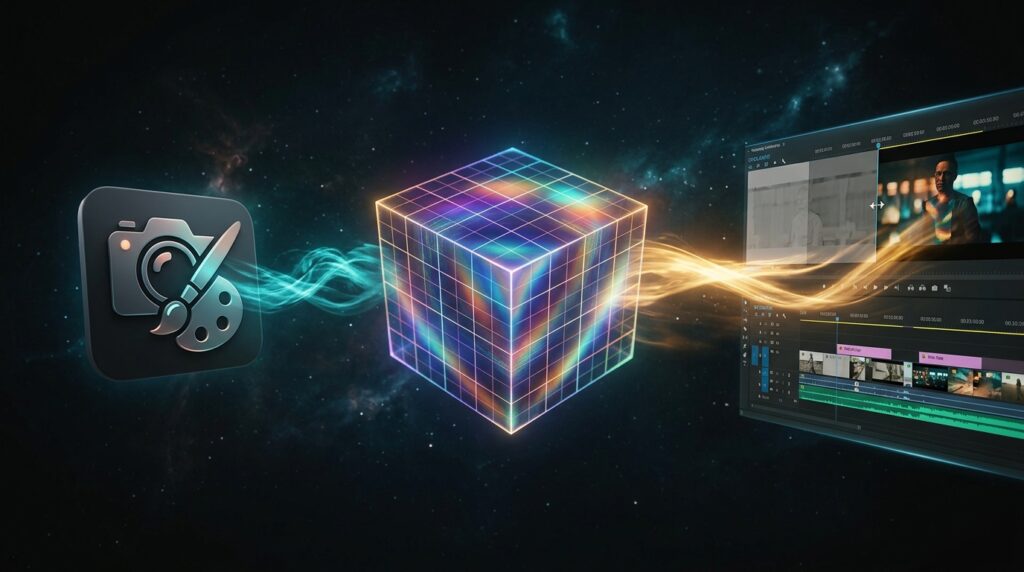
A three-dimensional linear transformation (LUT) takes the form of a mathematical map that converts one set of color values into another. The LUT is a tool that stores how certain colors should change when applied to an image or video frame. This is in contrast to the traditional method of recording visual modifications directly. On the other hand, a 3D LUT generates a universal color conversion system that is capable of functioning across a variety of platforms, in contrast to typical presets, which may be dependent on software-specific changes. In the context of a color cube, the three-dimensional structure refers to the manner in which the red, green, and blue color values interact with one another to generate modified output values. Because of this, LUTs are able to maintain intricate color relationships, such as tonal changes, contrast alterations, and cinematic grading techniques. It is essential to have a solid understanding of this structure since it explains why LUTs are able to retain a consistent visual behavior across different editing environments.
The Process of Establishing a Solid Foundation in Photoshop
A thorough design of the color grade inside Photoshop is required before exporting a LUT. This is due to the fact that every change will be included in the transformation profile that is produced. The core corrections, which include exposure balancing, white balance refining, and contrast changes, are often the first step in the process for grading. Following the completion of the neutral and technically balanced basic picture, the next step is to apply creative grading layers in order to achieve the desired visual style. Curves, Selective Color, Color Balance, Gradient Maps, and Camera Raw adjustments are some of the most common and widely used techniques for shaping the final appearance. In order to guarantee that the LUT will generate accurate results when applied to different media, it is necessary to construct a grading system that is both clean and deliberate. Uneven or excessive transformations in video processes might be the result of source grades that are not well balanced.
Adjustment Layers for the Creation of Non-Destructive LUTs Through Their Use
When it comes to the preparation of LUTs, non-destructive editing is very necessary since it enables continual improvement well before export. Providing versatility, adjustment layers divide particular grading actions into editable components. This allows for more customization. Through the use of this framework, it is much simpler to identify certain color or tonal adjustments and assess the extent to which they contribute to the overall grade. The organization of modifications in a logical manner also increases compatibility. This is due to the fact that effects that are too complicated or unsupported could not convert effectively into LUT data. Depending on the export settings, some Photoshop functions, such as blending modes or localized masking, may react in an unpredictable manner. Utilizing adjustment layers in a planned manner guarantees that the final LUT will continue to be clean, portable, and visually consistent across all applications.
Conceptualizing Color Profiles That Are Both Cinematic and Brand-Specific
The capacity to develop one-of-a-kind visual identities for businesses, campaigns, or cinematic productions is one of the most significant benefits that comes with the provision of custom LUT creation. A meticulously crafted LUT has the ability to dictate the behavior of shadows, highlights, skin tones, and ambient colors across all content. When it comes to creating atmosphere and depth, cinematic grades often depend on color relationships that are complimentary to one another, such as cold shadows and warm highlights. It is possible for brand-focused LUTs to highlight certain corporate colors while yet preserving natural skin tones and keeping a balanced contrast. It is particularly crucial to maintain consistency when producing content for several platforms since viewers anticipate a consistent visual experience regardless of whether the material is presented in the form of photography, video, or advertising graphics. There is a correlation between the design of LUTs with a purposeful color strategy and the enhancement of narrative and brand identification.
Making adjustments in Photoshop and exporting them as 3D LUT files
Photoshop enables the adjustment stack to be exported as a 3D LUT file after the grading structure has been perfected and finished. Photoshop will convert the visible color alterations into a LUT format that is compatible with a variety of editing tools while the export process is taking place. There is a selection of LUT file formats available, each of which is purpose-built for a distinct workflow and software environment. The criteria for compatibility and the environment in which the video editing will take place also play a role in the selection of the right format. It is also important that the export parameters maintain color accuracy in order to prevent unwelcome banding or tonal movement. In order to guarantee that LUT files continue to be available and simple to include into larger production pipelines, it is essential to always maintain an orderly export methodology.
Utilising LUTs Across All Video Editing Platforms Applications
Immediately after the export, the LUT may be loaded into video editing and color grading apps in order to recreate the color profile of Photoshop in a manner that is constant throughout moving footage. This technique makes it possible to extend color grading approaches from still images into video projects in a smooth manner, hence preserving visual consistency across different media. A frequent use of LUTs occurs inside editing software at the step of color correction or creative grading. Due to the fact that video footage often incorporates a variety of exposure and lighting settings, it is possible that extra modifications may still be required in order to get the desired final appearance. Nevertheless, the LUT helps to provide a solid foundation, which not only speeds up the grading process but also guarantees that the project will maintain a consistent approach to style throughout.
Taking Control of Color Spaces and Maintaining Gamma Standards
In the realm of color spaces and gamma interpretation, cross-platform processes present several obstacles. If adequate color management is not implemented, a LUT that was developed in one color environment may seem differently when applied in another color environment. When it comes to proper LUT performance, it is very necessary to have a solid understanding of the connection between color profiles like sRGB and Rec.709 as well as larger cinematic color spaces. There is also the possibility that gamma discrepancies will influence the perception of shadow detail and contrast across apps. Keeping the color management settings constant throughout the process helps to reduce the likelihood of these problems occurring and ensures that the visual result is predictable. When distributing information for numerous devices or platforms, it is essential to do calibration and testing using the appropriate procedures.
Finding Solutions to the Most Frequent Issues in LUT-Based Workflows
It is possible for bespoke LUTs to be less effective due to a number of regular faults. There is a possibility that when applied to separate material, grading alterations that are very severe may result in clipped highlights, crushed shadows, or odd skin tones. The use of Photoshop effects that are not supported might potentially result in output inconsistencies or transformations that are unexpected or unpredictable. The use of LUTs to film that has an exposure or color balance that is incompatible with the LUT, which results in distorted results, is another common situation. Performing LUT testing on a number of different photos and video clips prior to the final deployment helps discover these issues at an earlier stage. In order to guarantee that bespoke LUTs continue to be flexible, dependable, and visually consistent across a variety of creative situations, it is necessary to maintain balanced grading structures and to have an awareness of platform-specific color psychology.