How to Use an Elgato Stream Deck to Control Photoshop Brushes and Layer Opacity Dynamically
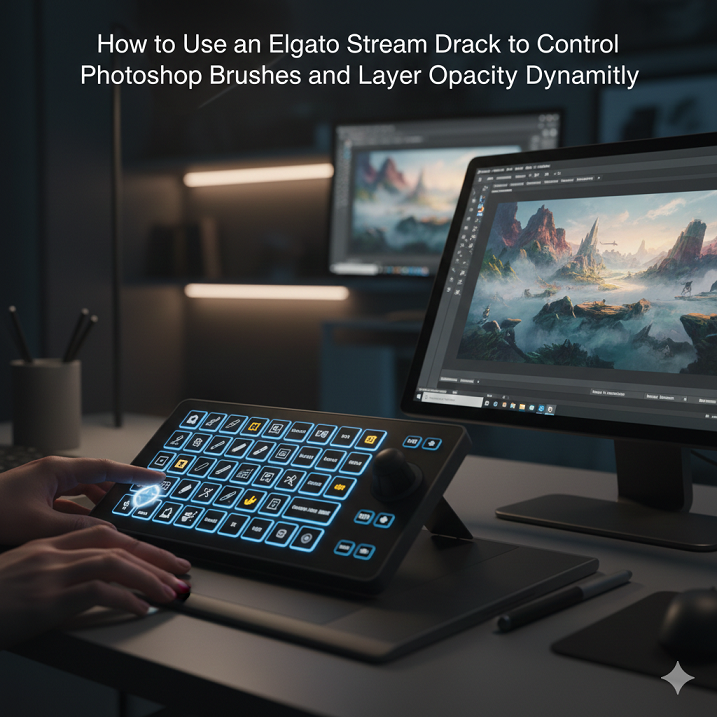
How to Use an Elgato Stream Deck to Control Photoshop Brushes and Layer Opacity Dynamically
Photoshop is a powerful creative tool; however, if you are constantly navigating menus, adjusting brush sizes, and modifying layer opacity, it can disrupt your workflow and slow down your productivity. An Elgato Stream Deck offers a one-of-a-kind solution by providing artists with physical buttons that can be customized and that can immediately trigger Photoshop commands. A tactile, real-time control panel that streamlines your workflow for digital painting, retouching, or compositing can be created by mapping brush settings, layer opacity, and even complex macros to the Stream Deck. This allows you to create a control panel that enhances your experience. This method not only helps you save time, but it also improves precision, which enables you to concentrate more on creative endeavors and less on the tedious process of navigating different interfaces.
Gaining an Understanding of the Capabilities of the Stream Deck
The Elgato Stream Deck is essentially a macro keyboard that can be customized to your liking. It features LCD buttons that can display icons, text, or live feedback information. Despite the fact that it is widely used by streamers for the purpose of managing broadcasts, it is also extremely powerful among creative applications. Within Photoshop, every button has the capability of being programmed to carry out a single action, a sequence of keystrokes, or to activate scripts that are triggered by third-party software. It is essential that you have a solid understanding of these capabilities because it enables you to design a control layout that is complementary to your workflow. This layout will provide you with instant access to brushes, opacity levels, or tool presets that you use frequently without diverting your attention away from the canvas.
The process of preparing Photoshop for integration with Stream Deck
Photoshop needs to be optimized for quick responses before actions can be mapped to the Stream Deck after it has been created. Make sure that the shortcuts you use on your keyboard for brushes, layer opacity adjustments, and any other functions that are necessary are customized and consistent between projects. To simplify the process of mapping to the Stream Deck, you might want to think about enabling Quick Actions, Actions Panel, and Function Key Shortcuts. In addition, ensuring that your control buttons execute commands accurately and reducing the likelihood of errors occurring during dynamic editing sessions can be accomplished by organizing brushes into groups, clearly naming layers, and consolidating opacity settings that are frequently used.
Setting up the Stream Deck Software and Plugins During Installation
For the purpose of configuring buttons and macros, the Elgato Stream Deck software is what is required. Expanding control options can also be accomplished by installing the Photoshop plugin or third-party utilities that are compatible with Photoshop, such as Keyboard Maestro (Mac) or AutoHotkey (Windows). These plugins make it possible for the Stream Deck to send complex commands, manipulate the dynamics of brushes, and adjust the opacity of brushes in real time. The Stream Deck and Photoshop are able to dynamically control brushes, layers, and other essential editing functions when the installation is done correctly. This ensures that there is no disruption in communication between the two programs.
Transferring the Brush Selection to the Buttons on the Stream Deck
Having the ability to assign particular brushes to buttons in order to make instant selections is one of the most helpful features. When using Photoshop, you can record brush presets or actions and then link them to the buttons on the Stream Deck. By doing so, you are able to switch between blending tools, textures, and detailed brushes without having to access the toolbar. Visual clarity can be improved by customizing the icons on the buttons with brush previews or descriptive labels. This will allow you to quickly identify and select brushes during complex painting or retouching sessions. The use of dynamic brush selection results in a significant increase in efficiency, particularly when working on lengthy or complicated projects.
Using Dynamic Control to Adjust the Size and Hardness of the Brush
Another powerful application of Stream Deck is the ability to make real-time adjustments to the brush’s size and hardness. You can assign dedicated buttons to keystrokes or actions that allow you to gradually increase or decrease the size of the brush, or toggle between different levels of hardness. For even more granular control, certain configurations even permit the combination of modifiers. This eliminates the need to access sliders within the interface of Photoshop, which enables smoother strokes and faster transitions between tools throughout the editing process. By enhancing precision and enabling real-time experimentation with brush characteristics, dynamic brush adjustment allows for the continuation of creative momentum without interrupting it.
Making Changes to the Opacity of Layers Using a Stream Deck
The control of the opacity of layers is an essential component of blending, masking, and compositing. You can quickly fade layers, fine-tune blending effects, or adjust transparency for complex compositions by mapping opacity values or incremental adjustments to Stream Deck buttons. This allows you to do all of these things. There are some configurations that allow you to gradually change the opacity by holding down a button, while other configurations use presets for common percentages such as 25%, 50%, or 75%. The ability to make precise adjustments during painting, retouching, or multi-layer editing is made possible by real-time opacity control, which improves both the speed and the creative accuracy of the process.
A Single Buttons Approach to Combining Multiple Steps of Action
Stream Deck is equipped with the capability to run complex sequences with just a single press thanks to its support for multi-step macros. In the case of Photoshop, this may involve selecting a brush, adjusting the opacity, and automatically switching to a particular layer. Using Photoshop to record these sequences as Actions and then linking them to buttons makes repetitive tasks easier to perform and reduces the amount of mental work required. Multi-step macros are especially helpful for workflows that involve multiple layers and tools at the same time, where it is necessary to make frequent edits, apply effects in a consistent manner, or streamline editing processes.
The Process of Customizing Button Layouts to Improve Workflow Overall
Stream Deck layouts that are well-organized have the potential to make a significant difference in terms of productivity. Maintain a logical organization of actions, opacity controls, and brushes that are related to one another, and make use of folder hierarchies for secondary functions. The distinction between brushes, tools, and layer adjustments can be made by assigning visually distinct icons or color codes to each of these categories. You will be able to navigate controls in an intuitive manner thanks to this layout, which will help you keep your attention on the artwork and minimize distractions. The Stream Deck can be transformed into an ergonomic extension of your workflow through careful arrangement.
Performance Evaluation and Adjustments to Your Configuration
Following the mapping of buttons, exhaustive testing is performed to ensure that each function operates as intended. During typical editing sessions, you should experiment with brush switches, opacity adjustments, and macro sequences in order to identify any inconsistencies or latency that may be present. The timing of multi-step macros can be adjusted, icons can be refined to improve clarity, and buttons can be reorganized to improve accessibility. Through consistent testing and improvement, you can make certain that your Stream Deck configuration will boost productivity rather than causing frustration or errors while you are working on creative projects.
The Integration of Stream Deck into Workflows That Involve Collaboration
It is possible to export and share Stream Deck configurations with other users, which allows for the standardization of workflows across multiple Photoshop installations. This is useful for teams or projects that involve collaboration. The importance of maintaining consistent brush settings, opacity adjustments, and action sequences makes this feature especially useful for creative agencies, shared creative spaces, or remote teams. Integration with collaborative workflows guarantees consistency, expedites the training process for new members of the team, and ensures that quality is maintained across all projects.
Ensuring that Stream Deck Profiles Are Maintained and Updated
Stream Deck profiles should be reviewed and updated on a regular basis as your workflow continues to develop. Include new brushes, get rid of actions that are no longer needed, and modify button layouts to accommodate newly arising tasks or requirements for the project. Because of its adaptability, the Stream Deck is capable of continuous optimization, which guarantees that it will continue to be in line with contemporary creative practices. Consistent updates eliminate clutter, preserve speed, and ensure that the hardware continues to be responsive to the ever-evolving requirements of your workflow.
Advantages of Using Stream Deck in conjunction with Dynamic Photoshop Control
Photoshop is transformed from a static interface into a responsive and tactile workspace when a Stream Deck is used to control the opacity of layers and brushes. Faster, more precise, and more fluid workflows are available to artists, which eliminates the need for repetitive menu navigation and allows them to concentrate more on making creative decisions. Not only does this setup improve efficiency when it comes to professional retouching, digital painting, or complex compositing, but it also reduces strain and repetitive motion, which makes long editing sessions more comfortable.
Expert Advice for Increasing Productivity to Its Fullest
Dynamic layer switching, undo/redo macros, adjustment layer shortcuts, and integrated shortcuts for external tools such as Lightroom and After Effects are some of the additional features that advanced users have the ability to explore. The combination of these functions results in the creation of an all-encompassing control hub that goes beyond Photoshop. It is possible to transform the Stream Deck into a central command center for digital workflows through the process of customization and experimentation. This results in an increase in both creativity and productivity in professional settings.
The Applicability of Stream Deck to Photoshop
By incorporating an Elgato Stream Deck into your Photoshop workflow, you can significantly improve the speed, precision, and comfort of your editing experience. Gaining real-time tactile control over the creative process can be accomplished through the use of mapping brushes, dynamically adjusting opacity, and creating macros featuring multiple steps. A Stream Deck setup transforms Photoshop into an environment that is more intuitive and efficient, allowing you to focus on creativity while minimizing the friction of repetitive tasks. This is true regardless of whether you are a professional designer, a digital artist, or a hobbyist.