How to Calibrate Your Smartphone Screen to Match Your PC Monitor for Accurate Social Media Posting
How to Calibrate Your Smartphone Screen to Match Your PC Monitor for Accurate Social Media Posting
A high level of precision is required when developing content for social media platforms, particularly when the colors, contrast, and brightness of the content must be consistent across all devices. Due to differences in display technologies, color profiles, and brightness levels, images and graphics that appear vivid on a personal computer monitor frequently appear dull, oversaturated, or washed out on a smartphone. It is essential for designers, photographers, and social media managers to calibrate the screen of their smartphone to match the screen of their personal computer in order to guarantee that the content they create is viewed in the manner that was intended. Maintaining color fidelity, avoiding misrepresenting brands, and producing content that appears professional across all devices are outcomes that can be achieved through the application of proper calibration.
Acquiring an Understanding of the Distinctions Between Computer Monitors and Displays on Smartphones
Screens on smartphones and monitors on personal computers use different display technologies, which can have an impact on how colors are rendered, contrast, and brightness. There are three types of panels used in most monitors: IPS, VA, and OLED. Each of these panels has its own color accuracy and viewing angles. In the meantime, AMOLED or LCD panels are frequently used in smartphones. These panels are optimized for brightness and vibrancy rather than producing accurate color reproduction. Because of these differences, an image that appears to be accurate on a monitor that has been calibrated may appear to be an excessively saturated or muted version on a mobile device. The first step toward achieving color consistency across multiple devices is to recognize the differences in hardware from one device to another.
The Reasons Why Color Accuracy Is Important for Content on Social Media
Branding can be undermined, products can be misrepresented, and engagement can be reduced when colors are not accurate. An example of this would be a product photo that appears slightly off on a smartphone, which could discourage potential buyers or lead to confusion regarding the various color options. One of the things that designers need to make sure is that what they see on a computer screen is very similar to what users see on their smartphones. When you calibrate your devices, you ensure that your visual messaging remains consistent, you protect the integrity of your brand, and you prevent the need for unnecessary edits after publishing.
Using Tools for Calibration on Your Personal Computer Monitor
The monitor on your personal computer needs to be calibrated precisely before you can calibrate your smartphone. It is possible to adjust the brightness, gamma, and color temperature of a display to conform to industry standards using software solutions such as X-Rite i1Display, Datacolor Spyder, or even free software application. When you calibrate your monitor correctly, you ensure that the source image you are using for social media is as accurate as it can possibly be. This provides you with a reliable reference for calibrating your mobile device. It is possible that any adjustments made to a smartphone could be based on inaccurate colors if the monitor is not properly calibrated. This would defeat the purpose of providing cross-device calibration.
Adjusting the Display Settings on a Smartphone System
The display settings on modern smartphones can be adjusted manually, which can help them better match your monitor. Utilize the display menu to make adjustments to the brightness, color temperature, and contrast. Certain mobile devices come equipped with color profiles that are referred to as “Natural,” “sRGB,” or “Standard,” all of which are preferable for providing an accurate representation. During the calibration process, you should steer clear of the “Vivid” and “Adaptive” modes because they artificially boost the saturation and brightness of the image, making it more difficult to achieve consistency with your personal computer monitor. By making adjustments to these settings, your smartphone will get closer to a baseline that is similar to that of a monitor.
Utilizing Calibration and Test Images in Your Device
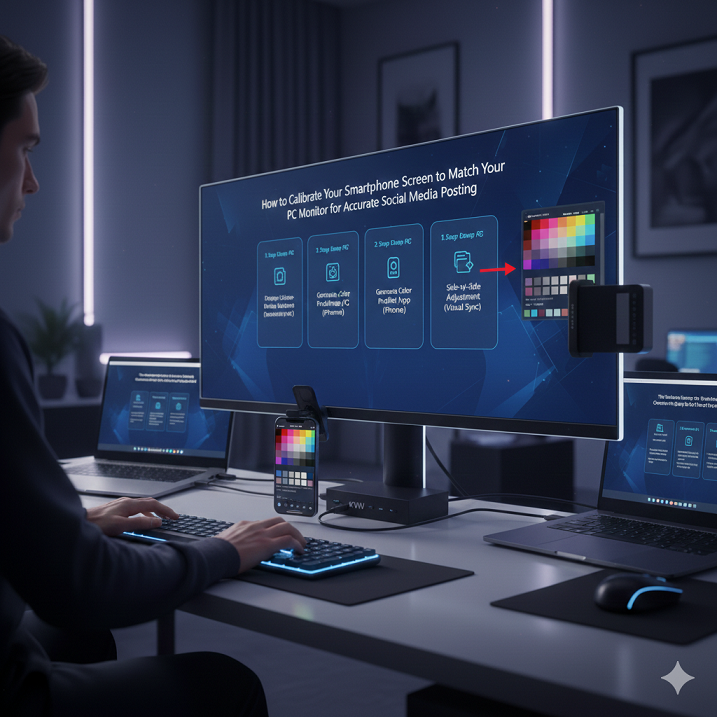
It is possible to align the screen of your smartphone with the screen of your personal computer by using specialized calibration apps and reference images. The ability to compare grayscale ramps, color blocks, and gradients between different devices can be accomplished through the use of applications such as Display Tester, Color Calibrator, or even test charts generated in Photoshop. You can achieve accurate color representation by adjusting the settings on your smartphone until the appearance of the reference images matches the appearance of the monitor. It is possible that this process will require multiple iterations; however, it is necessary for achieving precision in social media visuals.
Taking Into Account the Localized Lighting Conditions
The colors that appear on monitors and smartphones are significantly impacted by the lighting that is present in the environment. In an ideal scenario, calibration should take place in conditions of lighting that are neutral and consistent. Steer clear of bright overhead lighting, direct sunlight, and colored ambient lights, all of which have the potential to distort perception. If you are using a smartphone, you should think about enabling adaptive brightness only after the calibration process is finished. This is because automatic adjustments can cause color and contrast to shift, which can cause images that were previously accurate to appear different depending on the lighting conditions.
Examining the Consistency of the White Balance
In order to achieve color matching, white balance is essential. Whites may be interpreted differently by personal computer monitors and smartphones, which can result in images appearing warmer or cooler depending on the device being used. Perform a comparison between the two screens using a reference image that is either neutral gray or white, and then adjust the color temperature or tint settings on the smartphone until the whites are level. In order to maintain the visual intent of your designs or photographs, it is essential to maintain a consistent white balance. This ensures that all other colors in your content remain proportionally accurate.
Real-world content testing across multiple devices
After the calibration is complete, use actual content from social media to verify that it is consistent. You should check for differences in saturation, contrast, and brightness by opening the same image or post on your smartphone at the same time as you do on your computer monitor. When necessary, make some minor adjustments to the display settings of the smartphone, and then test it again until the content appears to be consistent. The purpose of this practical testing is to ensure that your posts appear professional to your audience and that your calibration process is able to effectively translate to real-world usage.
Preserving Calibration Over the Course of Time
It is possible for the color accuracy of smartphone displays to deteriorate over time as a result of aging pixels and software updates. Especially if you notice changes in color perception, you should recalibrate both your personal computer monitor and your smartphone on a regular basis. Your settings should be documented for easy reference, and you should think about recalibration after major operating system updates or after prolonged exposure to lighting conditions that are either extremely bright or extremely dark. When consistency is maintained, long-term reliability for social media posting is ensured, and unexpected color shifts in published content are avoided.
A Reason Why Investing in Calibrating Devices Is a Worthwhile Choice
Investing time in calibrating your smartphone to match the monitor on your personal computer will pay off in the form of content that is of professional quality. The accurate representation of colors improves the visual appeal of a product, strengthens the identity of the brand, and prevents expensive corrections after it has been posted. The purpose of this step is to bridge the gap between desktop production environments and mobile consumption settings for content creators. This step ensures that your social media posts appear exactly as you intended them to appear to viewers on any device.
Specifications for External Calibration Equipment: Advanced Considerations
An additional option for creators who are looking for the highest possible level of precision is the availability of external hardware calibration tools for smartphones. In order to measure the output of the display and provide detailed adjustments for brightness, gamma, and color balance, these tools make use of colorimeters or spectrophotometers. Despite the fact that these devices are not strictly necessary for casual users of social media, they can be extremely useful for professional photographers, designers, or agencies that require color fidelity to be maintained across multiple platforms.
Your Workflow Will Benefit from the Integration of Cross-Device Calibration
After the calibration process is complete, incorporate cross-device color checking into your workflow for content creation. A post should always be reviewed on both a personal computer and a smartphone before it is published, and calibration settings should be saved as reference profiles. This routine ensures that your social media visuals continue to maintain a professional quality regardless of the platform or device that your audience uses. It also prevents inconsistencies from creeping into your workflow, which is a significant benefit.
Final Reflections on the Calibration of Displays Across Multiple Devices
The process of calibrating the screen of your smartphone to match the monitor of your personal computer is an essential step for anyone who is creating high-quality, color-accurate content for social media. It is possible to achieve a consistent and reliable visual presentation by first gaining an understanding of the differences between displays, then adjusting settings, then utilizing calibration tools, and finally testing content across multiple devices. This ensures that your posts continue to have the impact that you intended, that your brand’s integrity is preserved, and that audiences continue to perceive them as professional, regardless of the device that they use to view them.