Windows Storage Spaces Explained: Creating Resilient Software Drive Pools for Long-Term Archiving
Windows Storage Spaces Explained: Creating Resilient Software Drive Pools for Long-Term Archiving
Keeping data on huge hard disks is not enough to accomplish long-term digital archiving; other steps are required. Over the course of time, as storage capacity expands and data collections continue to expand, the dangers that are connected with hardware failure, fragmented storage management, and poor backup procedures become substantially more severe. Windows Storage Spaces is a software-defined storage solution that was built to enable the combination of numerous physical drives into storage pools that are both flexible and robust. Storage Spaces, in contrast to conventional single-disk storage configurations, offers redundancy, scalability, and superior data organization without necessitating the use of specialist hardware RAID controllers. Because of this, it is especially appealing for use in applications that need long-term archiving and where stability and expandability are more critical than maximum speed. To construct a reliable archiving system that is able to safeguard vital data over lengthy periods of time, it is necessary to have a solid understanding of how Storage Spaces handles virtual disks, redundancy modes, and drive pools via its management. When set appropriately, Storage Spaces provides a method of long-term data preservation that is both cost-effective and versatile.
The Importance of Comprehending the Function of Windows Storage Spaces
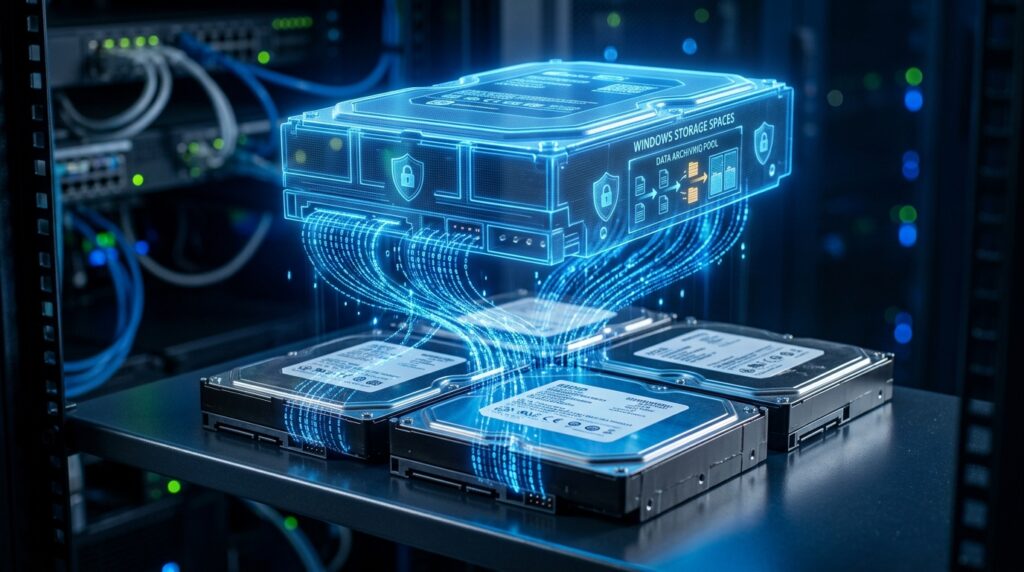
Windows Storage Spaces is a recent version of Windows that includes a storage virtualization technology that is based on software. One of its key functions is to consolidate a number of physical drives into a single storage pool that may be operated as a single virtual drive or as numerous virtual drives respectively. By abstracting the actual hardware into a storage environment that is flexible, Storage Spaces eliminates the need to give each disk a different drive letter and manage them individually. This makes it possible for customers to simply increase their storage capacity by adding additional drives to the pool over the course of time. Particularly essential is the fact that Storage Spaces allows for redundancy setups, which safeguard data against the failure of drives. Through the separation of logical storage management from the restrictions of physical hardware, the system offers more flexibility for the development of long-term archival storage procedures.
A Look at the Workings of Storage Pools and Virtual Drives
The storage pools and virtual drives that make up Storage Spaces are the fundamental components. The term “storage pool” refers to a collection of physical disks that are pooled together and managed by a single layer. A storage space is a kind of virtual drive that users construct inside this pool. Storage spaces perform the same functions as conventional Windows drives, but they pull capacity dynamically from the whole pool. It is possible to design these virtual disks with a variety of resilience settings, depending on the needs for both performance and protection. Considering that storage areas are virtualized, it is also possible to enlarge them without having to reformat them in the event that new drives are added at a later time. In addition to reducing the difficulty of maintaining several separate drives, this adaptable design makes it easier to manage long-term storage expansion.
Recognizing the Different Resiliency Modes for the Protection of Data
The capacity of Storage Spaces to provide data redundancy by means of resilience modes is among the most significant characteristics of this storage solution. The mirrored setup is the most straightforward approach, which involves storing copies of data across many disks in order to safeguard against the possibility of hardware failure. Parity modes that are more sophisticated spread data and parity information over several drives, which improves storage efficiency while still allowing for recovery in the event of specific drive failures. Your workload priorities, such as speed, capacity efficiency, and fault tolerance, will determine whether you should choose a mirror configuration or a parity design. When it comes to long-term archival storage, resilience is often more significant than raw performance. This is due to the fact that the primary purpose is to maintain the integrity of the data over a period of many years.
The Advantages of Utilizing Software-Based Storage Pools for Archiving
When it comes to traditional hardware RAID systems, separate controllers are required, and the recovery processes are sometimes difficult in the event that the hardware fails. By controlling redundancy directly via the operating system, Storage Spaces has the ability to circumvent a significant number of these constraints. Due to the fact that customers are able to mix drive sizes and expand capacity progressively, this software-defined method enhances flexibility and simplifies growth. It is particularly beneficial for archival systems to have this flexibility since storage requirements often increase in an unpredictable manner over time. Software-based management also enhances hardware independence, decreasing dependency on proprietary RAID configurations that may become difficult to maintain in the future. This is another benefit of software-related management. Because of this, Storage Spaces are especially useful for methods that include the long-term preservation of digital content.
When it comes to long-term storage, selecting the appropriate drives
When it comes to the dependability of a Storage Spaces archive, the quality and consistency of the physical disks that are associated with the pool are very important factors. When designing drives for long-term usage, it is important to emphasize durability, consistent firmware behavior, and predictable performance characteristics. When you combine drives with radically differing speeds or reliability classes, you run the risk of producing undesirable behavior inside the storage pool. Large-capacity drives that are built for continuous operation are typically chosen over consumer-grade drives that are tuned for burst performance when it comes to archiving applications. Due to the fact that long-term storage systems often stay operational throughout the day, it is essential to ensure that they have enough cooling and reliable power supply. There is a direct correlation between the quality of the hardware and the durability and lifetime of the overall archive environment.
Striking a Balance Between Performance, Redundancy, and Capacity
Utilizable capacity, redundancy, and performance are all factors that must be considered in any archive storage setup. Mirror arrangements provide enhanced security and reduced rebuild times, but they need more physical storage capacity due to the fact that these systems duplicate data. However, parity setups may result in slower write performance and longer recovery operations. This is because they reduce the overhead of redundancy, which improves storage efficiency. In the process of creating a storage pool for long-term usage, it is vital to have a thorough understanding of these tradeoffs. When the material that is being saved undergoes infrequent changes, archival systems often place a higher priority on the integrity and recoverability of the data than they do on the maximum speed. By maintaining a careful equilibrium between these elements, the storage environment will continue to be both functional and robust over a period of many years.
Safely Increasing the Capacity of Storage Pools Over Time
Storage Spaces has a number of significant benefits, one of the most important of which is the capability to gradually increase capacity without having to rebuild the whole storage system. It is possible to add new drives to the storage pool and incorporate them into the virtual drives that are already there in order to accommodate growing archiving needs. Because customers do not have to make an initial prediction about the eventual storage needs, this scalability makes long-term planning more simpler. It is important to exercise caution while expanding, however, in order to preserve a balanced redundancy and prevent an unequal distribution of data. In order to maintain the integrity of the system’s resilience, it is essential to perform routine monitoring of the pool’s health and the drive’s state following updates. It is possible for archiving systems to progressively grow via controlled expansion while yet securely preserving the data that is already there.
Upholding the Integrity of Data in Long-Term Archives
The use of redundancy alone is not sufficient for the long-term preservation of digital content. In the long run, archived material may still be at risk due to factors such as file corruption, silent data deterioration, and the aging of technology. When paired with resilient file systems, Storage Spaces’ integrity capabilities are able to automatically identify and correct certain types of corruption. These features are especially helpful when used in conjunction with robust file systems. Regular verification, backup methods, and environmental management are all additional ways to increase the dependability over the long run. An further benefit of proactive drive health monitoring is that it helps spot failing disks before data loss happens. A resilient archiving approach is one that incorporates redundancy, integrity verification, and regular maintenance methods in order to guarantee that the information that is stored will continue to be accessible and unaltered for a considerable amount of time.